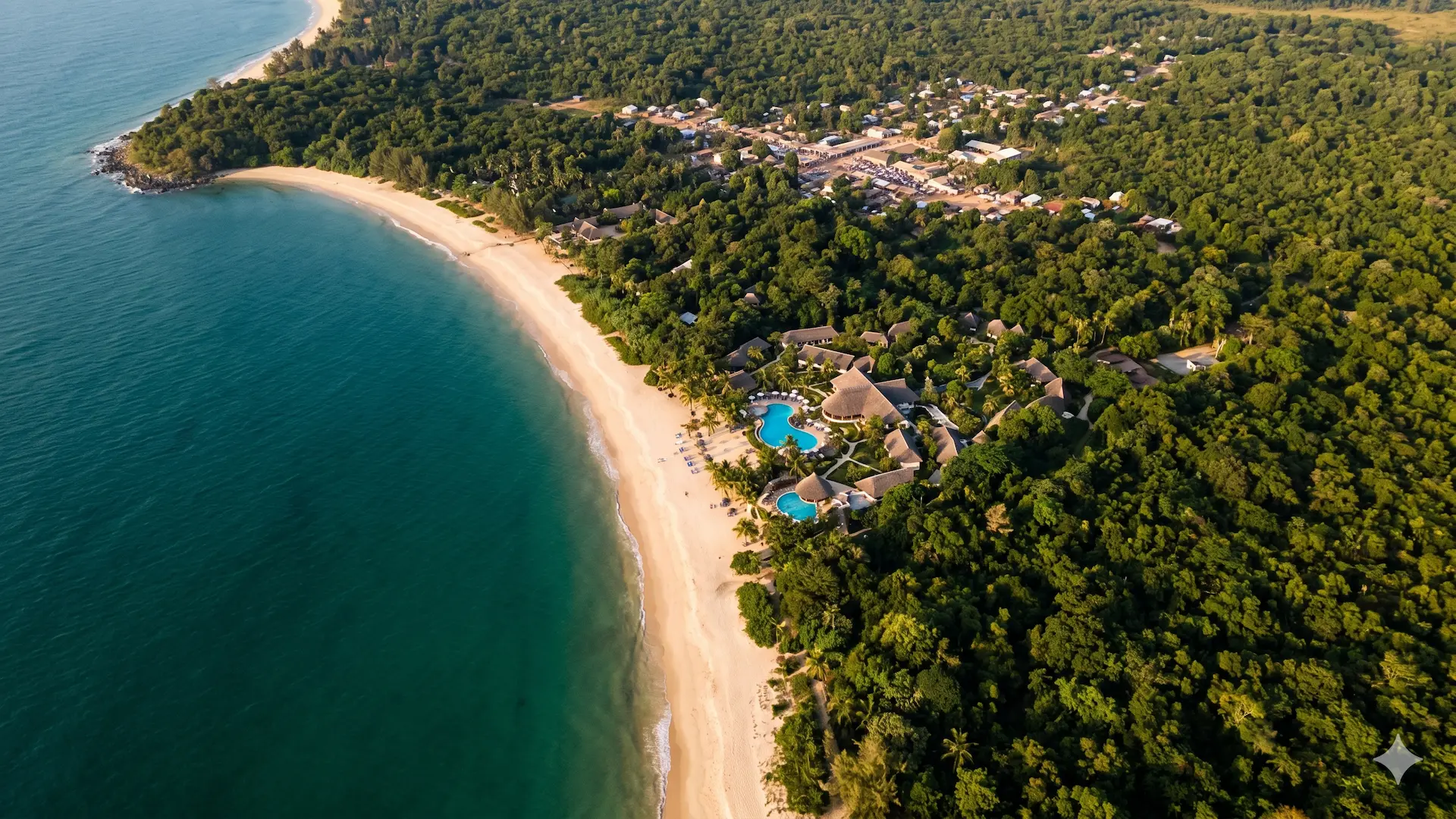
Cap Skirring sits at the southern end of the Casamance, where Senegal narrows into a forested peninsula between the Atlantic and the Casamance estuary. The beach is the draw — a 6 km arc of pale-gold sand, backed by woodland, washed by warm, clear water, and still far emptier than the equivalent in Morocco or the Gambian strip. Plenty of people will tell you it's the best beach in Senegal, and they have a case.
The Casamance has long been the country's greenest, most forested, most culturally layered region, and Cap Skirring wears that quietly: good hotels, reliable surf, and a fishing community still launching pirogues at dawn. The unhurried feel here is the real thing, not a marketing line.
The beach
The main beach runs roughly 6 km along the town's western side before curving north to the fishing harbour. Pale-gold sand, clear greenish-blue water, a gentle gradient — good for swimming, better for surfing.
Swimming: Water sits at 25–28°C from November through March, and the break is mostly gentle along the central beach. Take more care in August and September, at the peak of the Atlantic swell. The stretch in front of the main hotels is lifeguarded in high season.
Surfing: Cap Skirring is quietly one of West Africa's better surf spots. The right-hand point break at the northern end is the most consistent, best on a mid-tide push between October and March. Several camps rent boards and teach — a half-day lesson with kit from CFA 15,000 (€23).
The fishing harbour: At the southern end, the Diola fishing community launches pirogues at first light. Be there around 6am when the boats come in, nets heavy with barracuda, grouper and carangue — it's a sight, and it's free.
The Casamance: beyond the beach
Kabrousse village: 4 km inland, the main Diola village for the area. The Diola are the Casamance's dominant group — animist-influenced traditions, rice-farming, some matrilineal inheritance. A local guide can set up a respectful visit; CFA 5,000–10,000 is a fair contribution to the village.
Forest walks: Dense woodland backs the coast. Walking or cycling the village tracks at dusk, as egrets drop into the silk-cotton trees to roost, is one of the quiet pleasures here. Your hotel can suggest routes; the walk to Kabrousse is well-trodden and easy.
Mangrove trips: The Casamance delta starts a few kilometres north. Half-day pirogue trips through the channels — kingfishers, herons, African fish eagles — go through most hotels or straight from the harbour. Around CFA 15,000–25,000 per boat (up to 8 people).
Where to stay
Le Barracuda is the established mid-range pick — beachfront bungalows in a mango garden, a pool, and a kitchen that does good Casamance seafood. From €80/night B&B in high season.
Cap Skirring Surf Camp is built for surfers, with daily surf checks, board rental and lessons in the rate. Communal feel; from €45/night.
La Casa del Mar is a smaller family-run guesthouse set back from the beach — excellent home cooking, attentive, and better value than the beachfront places. From €40/night.
Savannah Club (the former Club Med, now independent) is the biggest resort on the beach — pool, watersports, all-inclusive option, tennis. From €110/night in high season.
Where to eat
Fish is the point. The harbour lands barracuda, grouper and shellfish daily.
Le Barracuda restaurant: the dependable choice — grilled fish and lobster on a terrace facing the sea. Mains CFA 6,000–12,000 (€9–18).
Beach grills: several informal charcoal grills run on the beach in high season, cooking the morning catch around midday. Follow the smoke. Fish with chips or rice, CFA 3,000–4,000 (€4–6).
Casamance home cooking: ask your guesthouse if they do evening meals. Yassa poulet (chicken in mustard-onion sauce) or ceebu jën eaten on a family terrace is the best meal you'll have here, and usually the cheapest.
Getting there
By air: Cap Skirring has a small airport (CSK), 3 km from town. Transair and Air Sénégal run seasonal flights from Dakar, about 50 minutes, 3–4 times a week in high season. Confirm before booking — schedules shift and some are dropped in low season.
By road via The Gambia: From Dakar, about 450 km. The usual route crosses The Gambia at the Brikama border and carries on south — 8–9 hours all in, including the crossings. You'll need valid visas for both countries if you're a third-country national.
By ferry to Ziguinchor: The overnight Dakar–Ziguinchor ferry (MV Aline Sitoé Diatta) is a West African classic — a big passenger boat that leaves Dakar in the evening and docks by morning. From Ziguinchor, sept-place shared taxis cover the 90 km to Cap Skirring in 2–3 hours. Book the ferry ahead November–January; it sells out.
When to go
- November–April (dry): Best. 28–33°C, low humidity, consistent surf, calm seas, the Casamance green and warm.
- May–June (shoulder): Fewer people, some afternoon showers, very good value, still great for swimming.
- July–October (wet): Heavy rain most days June–September. The forest turns vivid and the surf is at its biggest — not a beach holiday, but superb for birding and landscape photos.