Affiliate disclosure: This guide contains booking links. If you use them we earn a small commission at no cost to you.
Between Dakar and Casamance, 130 km south of the capital, a web of rivers, creeks, mangrove channels, baobab islands and fishing villages makes up one of the richest wetlands in West Africa. The Sine-Saloum Delta is a UNESCO Biosphere Reserve, and for birders and slow travellers it's one of the best reasons to come to Senegal.
Quick facts
- Distance from Dakar: ~130 km south (2–2.5 hours by road)
- UNESCO status: Man and Biosphere Reserve
- Best months: November–April (dry season; peak birdlife Nov–Feb)
- Key activities: Boat trips, birdwatching, kayaking, oyster harvest, Serer village visits
- Getting there: Private car or sept-place to Ndangane, Foundiougne or Toubacouta
Why the Sine-Saloum Delta
The delta is where the Sine and Saloum rivers meet the Atlantic: 180,000 hectares of tidal channels, mangrove forest, shellfish beds, baobab-studded islands and open lagoons. The birding is the headline — African fish eagles, Goliath herons, flamingos, white pelicans, several kingfisher species, western reef herons, and a wide range of waders and wildfowl, all present in the dry season.
Beyond the birds, the delta communities are Serer — distinct from the Wolof majority to the north, with their own fishing traditions, village architecture (many villages are reachable only by boat) and cooking.
Getting there
From Dakar
The usual gateways are Ndangane or Djiffer, via Fatick (3.5–4 hours from Dakar by private car or shared sept-place). Toubacouta in the south (near Kaolack) is a second gateway, used by the better eco-lodges, and about the same drive.
Most visitors hire a driver in Dakar (XOF 60,000–90,000) and go straight to their lodge, which then runs all the on-water activities.
En route from Saly
Already at Saly on the Petite Côte (1 hour north of Dakar)? The delta is an easy extension — 2 hours further south. Plenty of 7–10 day itineraries run Dakar → Saly → Sine-Saloum → back north.
The main areas
Ndangane / Mar Lodj — the northern delta. Ndangane is the main town; Mar Lodj is a car-free island 10 minutes away by pirogue. Several lodges here.
Djiffer — the southern tip of the Petite Côte, gateway to the Sangomar spit and the open lagoon.
Toubacouta — the south: more remote, quieter, with the best eco-lodges. The island of Betanti is a pelican and cormorant nesting site, a short boat trip away.
Île de Mar and the interior islands — boat-only, with Serer fishing villages still using traditional methods.
What to do
Boat trip through the mangroves
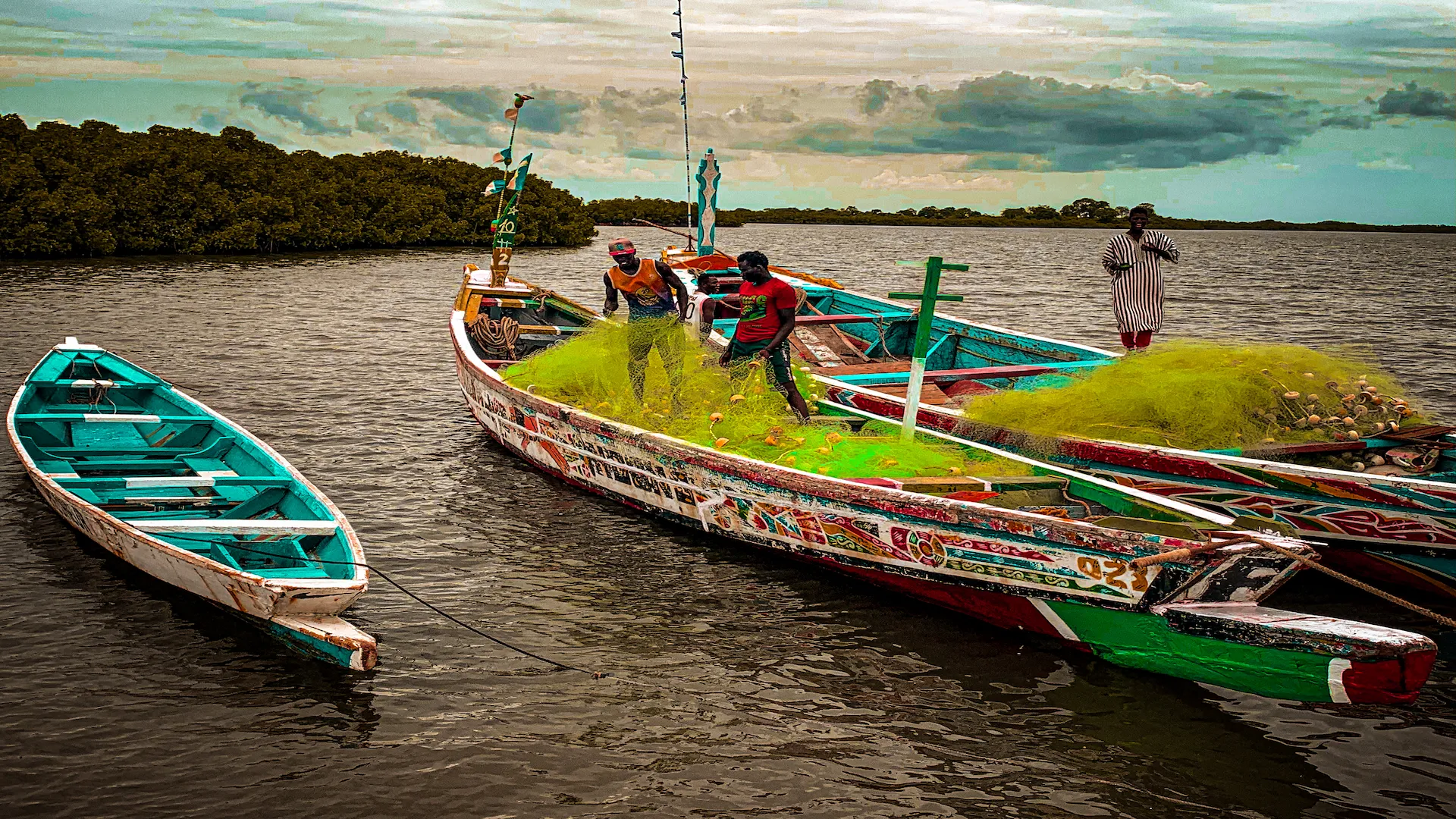
The core Sine-Saloum activity. A half-day pirogue trip (4–5 hours, usually included with a lodge stay) takes in mangrove channels, open lagoon and island stops, with wildlife close up — African fish eagles a few metres off, hippos in some areas, monitor lizards on the banks, hundreds of birds. Take binoculars.
Most lodges run their own trips with knowledgeable local guides. Sine-Saloum Delta boat trips on Viator
Birdwatching
The delta regularly turns up 200–300 species for visiting birders. Top targets: African fish eagle, Goliath heron, lesser flamingo, Caspian tern, white pelican (big concentrations at Betanti November–February), African spoonbill, Pel's fishing owl (rare, possible in the mangroves), African harrier-hawk, and various kingfishers, bee-eaters and sunbirds.
November to February is peak migration; residents are around all year.
Oyster harvest
Oysters grow on the mangrove roots throughout the delta, and the Serer women harvest them at low tide. Several lodges run early-morning trips to watch the harvest and eat oysters on the boat — one of the best food experiences in Senegal.
Kayaking
The creeks between the channels are navigable by sea-kayak at medium and high tide. Several lodges have them; the pace is slower than a pirogue and you get into narrower channels. Half-day from XOF 10,000.
Village visits
Boat access to the Serer fishing villages on the interior islands — Ndangane, Guior, Île de Mar — is easily arranged through lodge staff. The architecture (raised houses, thatched compounds, communal fishing setups) is distinctive. Go with a guide and a small community contribution.
Where to stay
Most accommodation is eco-lodge style — thatched bungalows or stilted cabins, often solar-powered, meals included. Book well ahead for November–February.
Mid-range (£80–150 per night, meals included):
- Lodge des Collines de Niassam (Toubacouta) — the area's most-written-about lodge, on stilts with mangrove views, excellent food, baboons at dawn
- Ecolodge Niakalé (Ndangane) — well-run, good boats, Mar Lodj access
Boutique / luxury (£150–250 per night):
- Lodge des Bolongs (Toubacouta) — overwater bungalows in the delta, a popular honeymoon choice
- Campement de Baobolong — remote, small, bespoke, with a true bush-camp feel
How long to stay
Two nights minimum — enough for two boat trips (morning and afternoon conditions differ a lot), good birding, and time to settle.
Three nights if birding is the main aim — you'll want several early starts, and the second morning is always better than the first.
Four nights for the full slow-travel version: the above plus kayaking, village visits and the oyster harvest.
Combining with other destinations
The delta drops naturally into the standard first-trip route between Dakar and Casamance:
7 days: Dakar (2n) → Saint-Louis (2n) → Sine-Saloum (2n) → back to Dakar
10 days: Dakar (2n) → Saint-Louis or Saly (2n) → Sine-Saloum (3n) → Dakar
14 days: Dakar (3n) → Saint-Louis + Lompoul (3n) → Sine-Saloum (3n) → Cap Skirring (3n) → Dakar
FAQ
Is the Sine-Saloum better than the Gambian birding sites?
Different rather than better. The Gambia (Abuko, Kotu Creek, Tanji) is compact and walkable — most sites do as single days from the Senegambia Strip. The Sine-Saloum is bigger, boat-based and more remote. The species lists overlap a lot; a dedicated birder should plan both countries.
Is it accessible without a car?
With difficulty. Sept-places run to Ndangane and to Kaolack (for Toubacouta). The better lodges can arrange pickup from transport hubs for a fee, or transfers from Dakar — sort it before you travel.
Are there really hippos in the delta?
Yes — a small population hangs on in the southern channels near Toubacouta. Sightings on boat trips are possible but not guaranteed; ask your lodge guide which channels are active.
Is it worth visiting outside the dry season?
For birding specialists, October and early May (the shoulders) have excellent residents and thinner crowds. The wet season (June–September) makes boat trips harder and closes some lodges.
More Senegal planning? Read the full Senegal holidays guide for itineraries, accommodation and what to eat. For northern birding see our Saint-Louis Senegal guide and the Djoudj section.