Affiliate disclosure: This post contains booking links. If you use them we earn a small commission at no cost to you.
Banjul to Dakar is about 6–8 hours of actual travel — though the Barra ferry and the Senegalese border can stretch that on a bad day. Here's every option: the Banjul–Barra river ferry, the road north through Senegal, private drivers, sept-place taxis, and what to expect at the crossings.
Quick-answer box
- Total distance: ~230 km (Banjul to Dakar)
- Total time (realistic): 6–9 hours including the ferry and border
- Ferry crossing: Banjul → Barra, River Gambia, ~30–45 minutes sailing + a variable wait
- Road after Barra: ~180 km through Senegal to Dakar
- Cheapest option: Sept-place taxi chain (~£10–14 total)
- Most comfortable: Private driver (£80–130 for the day)
Step 1 — Getting to Banjul ferry terminal
The terminal is at the northern tip of Banjul city. From Kololi or Kotu by taxi: D200–350 depending on how you negotiate. Allow 30–45 minutes from the strip in normal traffic — Banjul mornings can be severe.
The terminal is busy and chaotic — vehicles, vendors, passengers and livestock all sharing one waiting area. Foot and vehicle queues are separate; foot passengers board last but wait less.
Step 2 — The Barra ferry
The BARRA Ferry and her sister vessels cross the River Gambia between Banjul and Barra — about 4 km. Sailing time is 30–45 minutes. Frequency varies: aim for early morning (06.00–09.00) to catch a departure before the midday queues. The ferry runs several times a day, but the schedule bends to maintenance and tide.
Foot passenger fare: D50–75 (about £0.65–1.00).
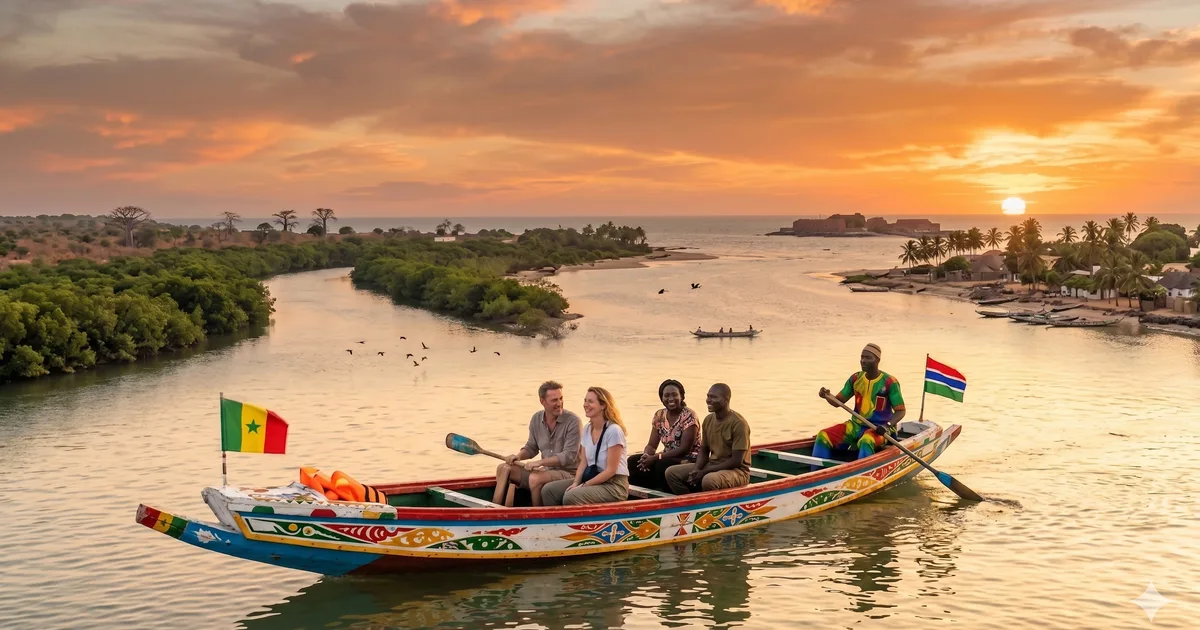
What to expect: Large, functional, crowded. Bring water and a snack if you're prone to travel impatience. The crossing itself — wide river, fishing pirogues, the Banjul skyline pulling away — is one of the better moments of the whole Banjul–Dakar route.
Avoid: Fridays and the day before a major holiday. The ferry backs up badly, and vehicle queues can mean 3–4 hour waits.
Step 3 — Barra and the Gambia exit border
In Barra, the Gambia Immigration post handles passport stamps — usually straightforward for UK citizens, 15–20 minutes in normal conditions. Have your passport, any immigration form, and your onward details ready.
Step 4 — Road to the Senegalese border
From Barra the road runs north into Senegal (The Gambia is entirely enclosed by it). The Senegalese border post at Karang is roughly 30–40 km from Barra, and most shared taxis from Barra run there directly.
Karang crossing: Senegalese Immigration stamps you in and may check bags — usually 20–40 minutes. CFA is accepted here; change some Dalasi before you cross, as Dakar rates are worse.
Step 5 — Karang to Dakar
Karang to Dakar is about 140 km on good roads (the toll motorway from Diamniadio is excellent). Sept-places run from Karang to Dakar's Gare Routière Lat Dior.
By sept-place: XOF 5,000–7,000 (£6–9) a seat, about 3–4 hours. Cramped, functional, the authentic intercity experience.
By private driver: if you hired one in Banjul, they take you to your Dakar hotel. Budget XOF 80,000–120,000 (£100–155) total Banjul–Dakar.
The full journey — options compared
| Option | Total cost (per person) | Total time | Comfort |
|---|---|---|---|
| Sept-place chain (Banjul → Barra ferry → Barra → Karang → Dakar) | £10–14 | 8–10 hours | Low |
| Private car/driver (Banjul to Dakar door-to-door) | £100–130 (whole car) | 6–8 hours | High |
| Organised transfer (tourist agencies in Kololi) | £35–55 per person | 7–9 hours | Medium |
The alternative — bridge route via Farafenni
To skip the Barra ferry entirely, cross the River Gambia at Farafenni on the Senegambian Bridge (opened 2019), 150 km east of Banjul. This route (Banjul → Farafenni → Kaolack → Dakar) is longer overall — 300+ km versus 230 — but avoids any ferry uncertainty. Useful if the Barra ferry is unreliable on your day.
Practical tips
- Start early. Aim to be at the Banjul terminal by 07.00–08.00. The day falls apart in proportion to how late you start.
- Have CFA before Karang. You can change money at the border, but the rates are poor.
- Carry snacks and water — there are no reliable stops between Karang and Dakar.
- Keep documents handy — passport, immigration papers, hotel confirmation — you'll show them at two crossings.
- A private driver is worth it with two or more people — split two ways it's £50–65 each for door-to-door.
FAQ
How long does the Barra ferry take?
The sailing is 30–45 minutes. With queuing and boarding, total time is 1–2.5 hours depending on the day.
Do I need a visa to cross into Senegal?
UK citizens currently enter Senegal visa-free for up to 90 days.
Can I take a vehicle on the ferry?
Yes — vehicles queue separately and pay more. Vehicle crossings are slower and more exposed to queue delays.
Is there a direct bus from Banjul to Dakar?
No direct scheduled service runs the full route. Some private operators in Kololi and Kotu run tourist transfers — ask your hotel.
What currency should I carry?
Gambian Dalasi for the Banjul side; CFA francs (XOF) once in Senegal. Euros change at Karang and in Dakar. Pounds change poorly outside Banjul.
Arriving in Dakar? Read our Dakar travel guide for where to stay and what to do. Heading back to The Gambia? The Senegal vs Gambia guide covers planning a two-country trip.